DIY INSTALLATION GUIDE
VINYL TILES & PLANKS
Installing vinyl tiles or planks yourself is not difficult and an average room can be completed in just a few hours after the necessary preparations have been completed. As with all DIY projects the end result depends upon using the right tools and methods from preparation to completion.
This Guide is intended to give you an understanding of the fundamentals of laying your vinyl tiles or planks and some tips on how to get it right the first time.
Depending upon what style and size of vinylflooring you have purchased you will naturally have an idea of the design you want to create, and a "minds eye" view of your finished project. We will now attempt to explain to you the logical order for your project to proceed from start to finish, just follow our step by step guide or download a pdf version below.
Let's begin!

Step 1
Tools for the Job
Now you have purchased your Vinyl tiles, what are the other essential items you should have on your shopping list?
Consider this list:
A heavy duty utility knife or "Stanley knife" with extra brand new heavy duty blades.

A solid scraper, heat gun and / or sanding equipment if you need to remove stubborn old glue.

A metal straight edge to cut along (at least) or at best a straight metal edge with a right angle, like a "Tri Square" that carpenters use. This is ideal to make double sure your cuts are all straight.

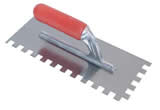
1.5mm Notched Trowel ( the above picture has bigger notches to illustrate only )
A marker pen.

A wooden surface or dedicated cutting mat to cut and trim down your Vinyl tiles if needed.

Vinyl glue. - The specialised glue sold by Carpettiles1 is an adhesive specifically designed for vinyl flooring.

OPTIONAL: For a professional finish it's worth hiring a roller from a hire company to bed the tiles to the glue properly. If you don't want to hire a roller, you can use a rubber mallet to remove air bubbles instead.


Step 2
Surface Preparation
More so than with any other flooring type, particular care needs to be paid to surface preparation before laying your Vinyl Tiles or Planks. By their nature, vinyl flooring will show through any imperfections with the subfloor, so it is essential to spend adequate time and be patient to prepare the subfloor before laying your Vinyl tiles.
Vinyl tiles are versatile in that they can be laid over any subfloor, but in most cases we recommend using levelling sheets to take out any imperfections.
Whatever the surface you are laying on, all traces of old Vinyl, Vinyl gripping, nails or screws, old glue, dirt and grime must be removed completely.
Just like painting, time spent on the initially preparing the surface that will be under your tiles will ensure your end result. Take the extra time at this stage to ensure that your installation comes up to the best possible



The floor surface should then be swept, mopped then vacuumed.
Fill any holes and seal the surface of your floor. This should be completed at this stage so you end up with the optimal fresh clean flat surface to begin your job.
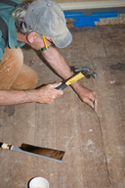


Laying new Vinyl Tiles over the top of Ceramic Tiles.
Vinyl tile flooring makes an easy way to recover your floors and freshen a room, and often can go right over the top of existing floors. In the case of ceramic tiles, its essential to chip out with a hammer and chisel any damaged or uneven tiles. These should then be filled in with levelling compound or mortar.
Once you have removed the imperfections, use a good quality ceramic tile sealer ( we recommend one from Holdfast ) as this prepares the tiles for accepting a new layer above, and seals them to ensure they don't leach the glue down into the ceramic tile, starving it from your new flooring.
Once your tiles are sealed, use Ardex Feather finish to infill grout lines and any other differences in the surface, to ensure your floor is perfectly level. When dry, spread your glue as mentioned below and start your installation.
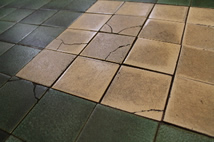

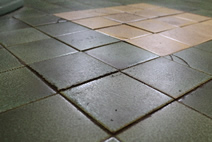
Laying new Vinyl Tiles over the top of old sheet Vinyl or old Vinyl Tiles.
Similar to laying over Ceramic tiles above, it is essential to remove any damaged tiles, infill any holes, and level the surface. Make sure you seal the old flooring to prevent it from leaching the glue from your new flooring.

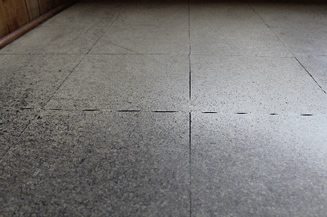
Again, infill the gaps and holes and level with feather finish to get your final subfloor surface in preparation to lay your new tiles as outlined in the below steps.
If there is any variance across your floor we recommend installing subfloor sheets, to level out the surface, remove any imperfections, rise or falls in your subfloor.
Vinyl flooring will show up any imperfections and changes in the subfloor, so if you are not able to get a perfectly level and clean surface with your existing subfloor we recommend that you install subfloor sheets to level out the imperfections.

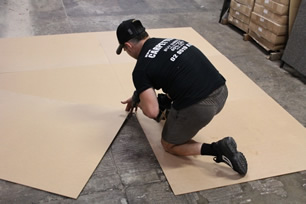
Cut and lay your sheets and fix them with screws or construction adhesive. It is important to make sure they will not move once the vinyl is laid onto them.
Fill any imperfections. We do stock self- leveller if you need it to help level and fill faults with your under-floor surface.
Once subfloor sheets have been laid, fill any seams between panels or planks, screw heads, nail holes or any other variance in the surface. We suggest using Feather Finish to fill these, as it dries in 15 minutes and provides a superior surface ready for you to install your vinyl tiles over the top.
Ardex Feather Finish is designed to give a hard durable flat surface very quickly so that any seams or imperfections can be filled and levelled before they become a problem.
Skim coat thejoints between subfloor panels, boards, screw heads nails or any other variance in the surface.
Allow the feather finish to dry, then sand to a smooth finish. In the meantime remove tiles from their boxes and prepare them to be layed.



Now you have floor that is ready to lay on, you can start unpacking your tiles.
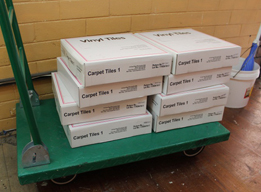
It is recommended that you allow your Vinyl tiles to acclimatise to your room for 48 hours before laying. We also suggest that you also unbox the tiles at least 24 hours before laying and leave them to sit flat, to allow them to acclimatise to room conditions, heat, and humidity.
Whilst this is taking place, have a good look at your tiles. Some have arrows on the back to indicate direction to lay, where others do not.
Those with arrows are to indicate direction to lay the tiles, whereas those without can be laid in a number of directions. Some of the tiles we carry have a linear pattern, which lays better when the pattern is given attention.
Plan out your installation and lay some tiles loose to determine the way to lay them for the best visual effect.
Even those without arrows will look better laid one way as opposed to just randomly placed on the ground.
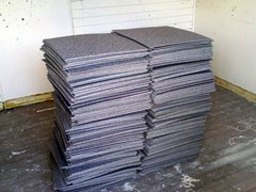
It is worth giving serious planning and consideration to the design options available to you when laying your tiles. As you will see on the following pages, there are several popular methods of laying out your tiles to create different design options.
Take a number of loose tiles, and lay them loose on a section of floor using the various patterns described on the following pages. This will help you determine what works best in yoursituation, and what looks best to your design taste and your individual application for the tiles.
Monolithic is by far the most common installation of vinyl tiles, whereas some of the other options will give your installation a completely different appearance.
Step 3
Decide on the way you wish to lay your Vinyl tiles
The most popular ways of laying Vinyl tiles are known as:
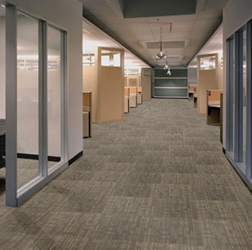
- "Monolithic" - This is where all the tiles are laid with the arrows or pattern all pointing in the same direction so laying is like building a pathway – you just lay all the tiles in thesame directions as the first tile. This will ensure a consistent look when the installation is complete. This is by far the most popular pattern or method used for installations. To mix it up a bit consider a border of a different tile colour to highlight the main floor area.

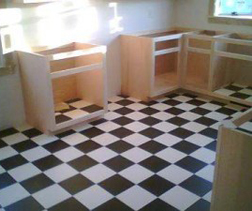
- "Two Tone / Checkerboard" – Using two different colours of Vinyl tiles creates a checkerboard effect. It is an effective way to break up colour so as to not overwhelm a room. Installation is the same as above; just select a different colour tile for each alternating tile.

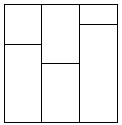
- Tiles can be offset by varying amounts to create different looks, for example offset by half, a third, or a quarter of a tile. These can be laid offset vertically ( Ashlar ) or horizontally ( Brick).

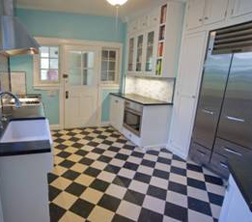
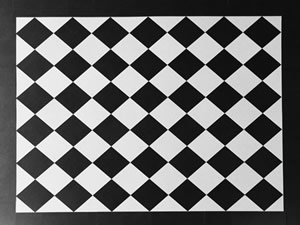
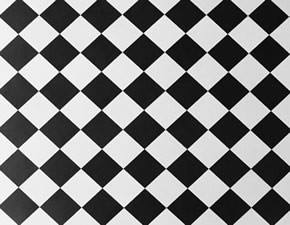
- "Two Tone / Diamond" – Using two different colours of Vinyl tiles creates a diagonal checkerboard effect. It is an effective way to break up colour so as to not overwhelm a room. It is also striking when used with a border around the main floor area. Installation is the same as above; just select a different colour tile for each alternating tile.

After discussion with our installers, they have drawn attention to the fact that in checker pattern installations, the eye is drawn to tiles that are not cut even or balanced from side to side. Their best solution is to make sure that the areawhich will be two-tone, uses only whole tiles, and that a border be added around the edge in one of the two colours.
This gives you space to make cuts around counters, edges and uneven walls by cutting the border tiles and not those that are two-tone. The other advantage is that it helps make your tiles stand out and keeps an even pattern of full tiles that remains pleasant to the eye.
With Border
Without Border
Step 4
Find and Mark the middle of the room.

- Using your chalk line its time to work out the centre of the room.
Measure along the length of your walls and mark the centre point of each of the walls.
Measure along the length of your walls and mark the centre point of each of the walls. It is important to measure each wall as often rooms are not exactly square and can be slightly out.
Position your chalk line and mark lines across the floor from side to side. Doing this across all walls should end up with a cross point in the centre of the room. It is important that these lines are square as they will be the guide for all your future efforts.
Take a moment and determine if they are square using the following methods.
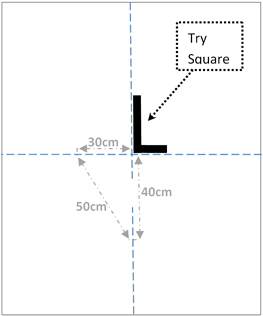
- If you do have a "Try Square" available, use it to place along the lines and make sure they line up square.
If you do not have a Try Square, it is not a problem as there is a simple way to work out if your lines are square.
Using a tape or ruler, measure and mark from the cross point out 40 centimetres. Now measure and mark along the other line out from the cross point out 30 centimetres.
Finally measure from one mark to the other mark. The distance between the two should be 50cm.
If it is not 50cm or your try square does not line up with your lines on both sides, your lines and room are not square and your tiles will not line up exactly with the walls. It is very common for rooms to be slightly out from square so do not worry if this is the case.
Assuming that your room is not square, there are several techniques you can use to mark your start lines square.
Following on from above we will use the same techniques described above to measure out points and mark lines that are square.
Step 5
Squaring up your guide lines.
Without a try Square:
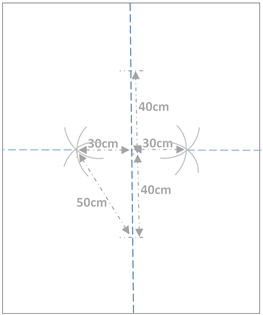
- Pick the opposite walls where the length of the walls is the closest, and use the chalk line from the centre of those walls to be your starting point.
Now that we know the centre point of that line ( from the step above ) measure back up that line 40cm on each side of the centre point.
From each of these points 40cm off centre, measure out 50cm and mark a small curve at 50cm from each of these points.
Next measure 30cm each side of the centre point and mark a small curve at 30cm from the centre point.
Finally line your chalk line to mark a straight line from one wall through the point where the three arcs meet, then through the centre point on the middle line, then through the other meeting point of the arcs on the other side, and finally out to the wall on the other side.
If done correctly, these lines will now be square and you are ready to progress to the next step.
With a try Square:
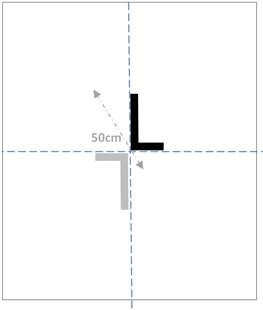
- If you have your try square, place the point of it at the centre point where the lines cross. Mark out the points each side from the end of the other arm of the try square. Do the same measuring the other side of the centre line.
Using your chalk line to then mark lines that go straight through the centre point where the lines cross and through the point where your points each side were marked using the try square and extend the new chalk line out to the walls each side.
If done correctly, these lines will now be square and you are ready to progress to the next step.
Step 6
Loose lay your tiles.
Taking your loose tiles, start at the centre and loose lay then out from the centre and work out the best fit for your room. Determine if you are better laying your tiles along the centre line, or down the middle of the centre line.
Lay tiles out from the centre and work out how many to each wall, and determine if you will need to trim tiles to fit to your room.
In the example to the left, if we laid the vertical centre row with the tile edge along the centre line, then we would need to cut each tile at the top and bottom in half to fit the room.
It is best to take the time now and plan out what looks best for your circumstances before we start to finally install the tiles. Once done, remove the tiles and vacuum ready for the next step.
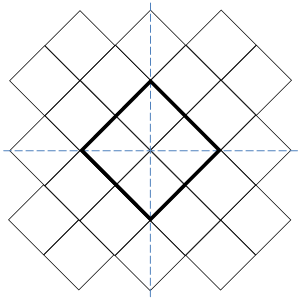
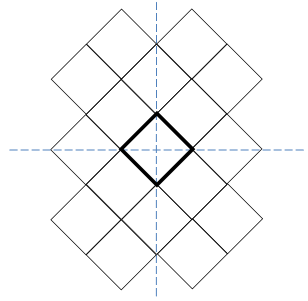
If you are going to lay your tiles in Diamond Pattern ( with or without a border) loose lay your tiles and determine if the centre point of the room will be in the centre of a tile, or if it will be where four tiles intersect.
It is best to determine this beforehand, and base the decision on which will give you the most whole tiles in your individual room.
Lay your square tiles out with their corners lined up along your lines to keep square.
With planks keep the long side offset at 45˚ to your square lines.
Step 7
Laying your tiles using Glue
- Ensuring that your floor is still clean and prepared in line with the instructions above, use a flat trowel or a roller, and apply the glue to the floor. When doing larger areas, focus on laying one section at a time then move on to the next section.
Make sure you keep the area well ventilated while you are gluing tiles.
The references to the adhesive in this guide are made to the adhesive sold by Carpet Tiles 1.
Other manufacturers instructions for glue application may be different. Follow the specific instructions for the glue you intend to use.
When the adhesive first goes down it is a cream / light grey colour. Allow it to go off, making it tacky and ready to lay the tiles. When the glue is ready to begin laying the colour changes from cream greyto a dull semi- transparent. This generally takes between 15-30 minutes depending upon climate in the room.
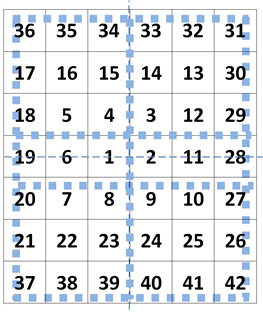
Starting in the centre of the room, do one full row from wall to wall. (Tiles 1-7 in the diagram to the left). If the tiles next to the wall need to be cut or trimmed to fit to the wall, leave them out for the moment and we will cut and place those as the last step. Continue laying alongside that first row and starting in the centre again, placing tiles up to the wall and down the row fit neatly against the row next to them.
Continue down the remaining rows, ensuring that each tile seats snugly and squarely against the other surrounding tiles. Lay all tiles that you can lay as full tiles before moving on to trimming and cutting tiles to fit remaining gaps and around pillars and other obstacles.
Please note that you can either follow the above numbering to lay to glue, do a quarter of the room then move to the next quarter of the room or follow a spiral laying sequence for laying your tiles.
In some installations you may also need to start from an access point like a doorway and line up to that, however you should always measure and plan form the centre point of the room.
Step 9
Cutting your tiles to walls and obstacles
Where you need to cut your tiles to fit between walls and the remaining tiles, or around obstacles in the room it is best to measure twice cut once. Remember to make sure that you take care to ensure your arrows on the back will all face the correct direction.
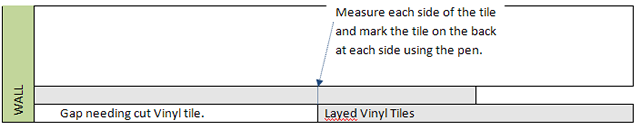
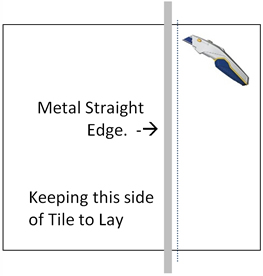
- Get your marked tile and put it face up, on the cutting mat or board.
Line up your metal straight edge or T-square between the two marks towards the side that will be laid so that if you accidentally make a mistake it will not affect the portion that will get laid on the floor.
Use your Utility knife or Stanley knife to cut a straight line in the "surfacewear" layer along the metal straight edge. The surface wear layer is the top layer of the tiles, not the underside.
Be very careful to take it slow so that your knife does not wander away from the straight edge. Cut and fit your tile, then move on to repeat the process for the remaining tiles.
Where you have poles pillars and other obstacles, Measure out where you need to cut your tiles and follow the above instructions in a similar fashion. Always remember it is better to cut out less tile than more as you can trim it down to fit in better, whereas if you cut out too much you will then have a gap or have to cut other slivers of tile to infill the mistake.
Roll / Mallet the Vinyl Tiles ( Optional ).
As a final step, consider using a roller or rubber mallet to bed the vinyl tiles down into the glue. Rollers can be hired from most equipment hire businesses for reasonable prices. This will ensure that your Vinyl tiles properly bond to the glue, remove any air bubbles and remain in place and stuck down for years to come.
If you have any questions...
Carpet Tiles 1 are always happy to answer any questions you may have about installing your tiles, to ensure you get the best installation possible for your room.
If you have any questions give us a call on 02 9519 8785 or 0414 266267 and we will gladly answer your questions.
Generally most people with DIY skills are capable of installing their own tiles, but If you feel installing your tiles is a little beyond your capabilities or your time constraints, we do have teams of installers that can come and quote for installing your tiles for you. This makes an easy alternative and normally involves the installer transporting the tiles, doing the preparation work required, installing them to your room(s) and removing the waste. Of course prices will differ depending upon the requirements of the installation, and whether you undertake parts of the above yourself in advance.
We are happy to meet with you quote for your needs, or answer any questions you may have, so please give us a call at Carpet tiles 1 on 02 9519 8785 or 0414 266267 and we can tailor a solution to meet your needs.